
Brown Patch Fungus in Hampton Roads: Why Your Fescue Turns Brown in Summer
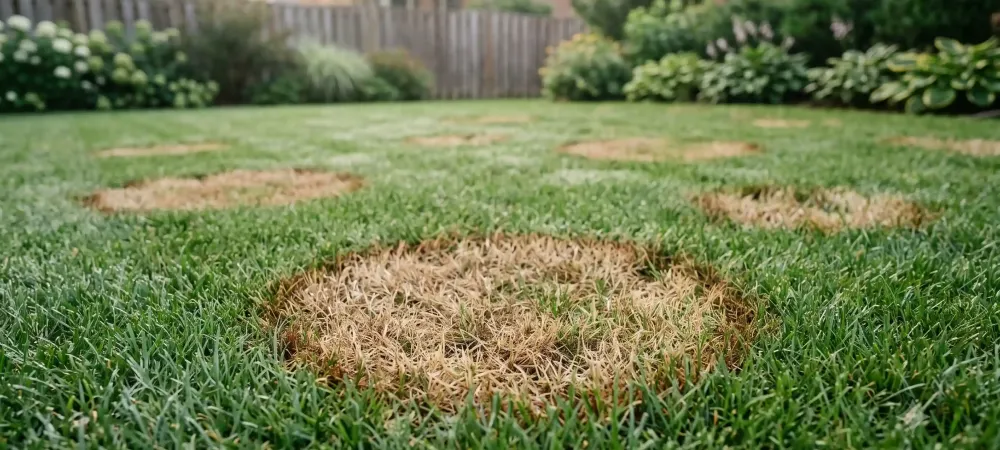
Brown patch fungus is the most common reason a tall fescue lawn develops circular brown areas in summer across Hampton Roads. The disease is caused by Rhizoctonia solani, a fungus that becomes active when nighttime temperatures stay above 68°F and daytime temperatures sit around 80°F or higher, with high humidity and long periods of leaf wetness (Penn State Extension, 2026). Coastal Virginia hits that combination through most of June, July, and August, which is exactly when fescue lawns here start to thin and discolor.
Tall fescue is one of the grasses most susceptible to brown patch. That matters in our area because much of the cool-season turf around Virginia Beach, Chesapeake, and Suffolk is tall fescue, and Tidewater sits near the southern edge of where fescue can comfortably grow. The same summer heat and humidity that make this a great place to live also push fescue into stress, and stressed grass is far easier for the fungus to infect. If you're unsure what type of grass you're working with, our guide to the best grass for Virginia lawns is a good starting point.
What does brown patch look like?
Brown patch shows up as roughly circular patches of light brown, thinned grass that can range from a few inches to several feet across. On tall fescue, you'll often see individual blades with tan or light brown lesions ringed by a darker brown border. In the early morning before the dew burns off, you may notice a fine, white, cobweb-like growth at the edges of a patch. That web is the fungus itself, and it's one of the clearest signs you're dealing with disease rather than drought or insects.
The patches tend to appear fast. A fescue lawn can look healthy one week and show several brown circles the next, usually after a stretch of hot days and warm, muggy nights. Mature lawns often recover once cooler, drier weather returns in late summer and fall, but new lawns less than a year old can be killed outright, so young fescue deserves closer attention (Clemson Cooperative Extension, 2026). For a closer look at how to tell disease apart from other causes of discoloration, see our post on brown patches in the lawn.
Brown patch or large patch? Why the grass type changes the answer
The grass you have determines whether you're fighting brown patch or large patch, and the two are managed on different calendars. Both diseases come from the same Rhizoctonia fungus, but they hit different turf at different times of year. Confusing one for the other is the most common reason a homeowner treats at the wrong time and sees no improvement.
Cool-season grasses like tall fescue get brown patch in the heat of summer. Warm-season grasses like zoysia, centipede, St. Augustine, and bermuda get large patch, and that disease is most active in fall and spring as the grass goes into or comes out of dormancy. Plenty of Tidewater lawns are warm-season turf, so knowing which grass is in your yard tells you which problem you actually have.
| Brown patch | Large patch | |
|---|---|---|
| Affects | Cool-season grass (tall fescue, ryegrass) | Warm-season grass (zoysia, centipede, St. Augustine, bermuda) |
| Peak season in Hampton Roads | June through August | Fall and spring, around dormancy |
| Trigger conditions | Hot days, warm humid nights, long leaf wetness | Cooler, wet weather during green-up or shutdown |
| Best treatment window | Preventive in early summer, before symptoms | Preventive in early fall, before dormancy |
If you're not sure which grass you have, the timing of the damage is a strong clue on its own. Patches that appear in the dead of summer point to brown patch on fescue. Patches that show up in October or during spring green-up point to large patch on warm-season turf.
Brown patch can also look a lot like gray leaf spot, another summer fescue disease, so it's worth ruling that out before you treat.
The watering mistake that makes brown patch worse
Watering more when your lawn browns out is the single most common mistake, and it feeds the fungus instead of fixing it. Brown patch thrives on moisture sitting on the grass blades overnight, so the instinct to "give the lawn more water" when it looks stressed often makes the disease spread faster. The problem in summer is usually fungus and heat stress, not a lack of water, and extra evening watering keeps the blades wet through exactly the warm, humid nights the fungus needs.
Water deeply but infrequently, and only in the early morning. Morning watering gives the blades all day to dry before nightfall, which breaks the leaf-wetness cycle the fungus depends on (Penn State Extension, 2026). Aim for roughly one to one and a half inches of water per week total, delivered in one or two deep soakings rather than a little every evening.
What actually controls brown patch on a Hampton Roads lawn
A few cultural practices do more to limit brown patch than any single product, and they cost nothing. Mow tall fescue at 3 to 3.5 inches in summer and keep the blade sharp, since a clean cut gives the fungus less surface to enter. Skip nitrogen fertilizer on fescue during the summer heat, because the lush new growth nitrogen produces is exactly what the fungus attacks first. Improving airflow and drainage in shaded, low spots helps too, since those areas hold moisture longest.
Overseeding with brown-patch-resistant fescue cultivars is the most effective long-term defense, and it pairs naturally with fall lawn seeding once the summer disease pressure breaks (Clemson Cooperative Extension, 2026). When disease pressure is heavy or the lawn is young and valuable, a preventive fungicide program is the reliable next step, and it works best applied before symptoms appear rather than after. Timing and product rotation matter, and store-bought single applications often fall short against a full season of pressure. This is the point where a professional lawn care program earns its keep, because the applications are scheduled to the disease cycle instead of guessed at after the damage is already visible.
When should I call a professional about brown patch?
Call a professional when patches keep spreading despite correct watering and mowing, when the lawn is less than a year old, or when you simply want the problem diagnosed correctly before spending money on treatment. Brown patch, large patch, drought stress, and grub damage can all look similar from a distance, and the right fix depends entirely on which one you actually have. A misdiagnosis usually means wasted product and a lawn that keeps declining through the worst of the summer.
The earlier the diagnosis, the more of the lawn you save. Mature fescue often bounces back from a mild case once the weather breaks, but heavy infections and young lawns don't always get that second chance, so the cost of waiting is real.
Dealing with brown, spreading patches in your yard, or just not sure what you're looking at? Call Agronomic Lawn Management at 757-563-8588 and we'll help you figure out whether it's disease, heat, or something else, and what the right next step is.
Sources
- Penn State Extension. Turfgrass Diseases: Brown Patch (Causal Fungus: Rhizoctonia solani). https://extension.psu.edu/turfgrass-diseases-brown-patch-causal-fungus-rhizoctonia-solani
- Clemson Cooperative Extension, Home & Garden Information Center. Brown Patch & Large Patch Diseases of Lawns. https://hgic.clemson.edu/factsheet/brown-patch-large-patch-diseases-of-lawns/
- Virginia Cooperative Extension (Virginia Tech). Turf and Garden Tips. https://ext.vt.edu/lawn-garden/turfandgardentips.html